Tell us about the job
Takes about a minute. No obligation.
A contractor sizing a mini-split in Dade County has to get the load calculation right before anything else, because the compressor will run hard through its entire active window without a gradual ramp to reveal installation errors. Homes in Dade County, MO run cooling about four months a year, from June through September. Across those months, the compressor starts and stops repeatedly, and a unit that is undersized for the space pushes its contactor and refrigerant circuit harder than the manufacturer's wear curve expects. A sloppy line set, a poorly seated refrigerant charge, or an indoor head mounted without enough clearance shows up fast when there is no slack in the schedule.
Wiring run for an earlier generation of heating and cooling does not automatically carry a mini-split. Half the homes in Dade County, Missouri were built in 1972 or earlier (2020-2024 ACS 5-year). A contractor installing a new system here checks the service panel before anything else, because what looked like adequate capacity for the original equipment can fall short of what the new unit demands on the same circuit. That gap between what the house was wired for and what runs in it today is where the installation either stays straightforward or picks up additional work.
The Mini-split System an HVAC Contractor Works With
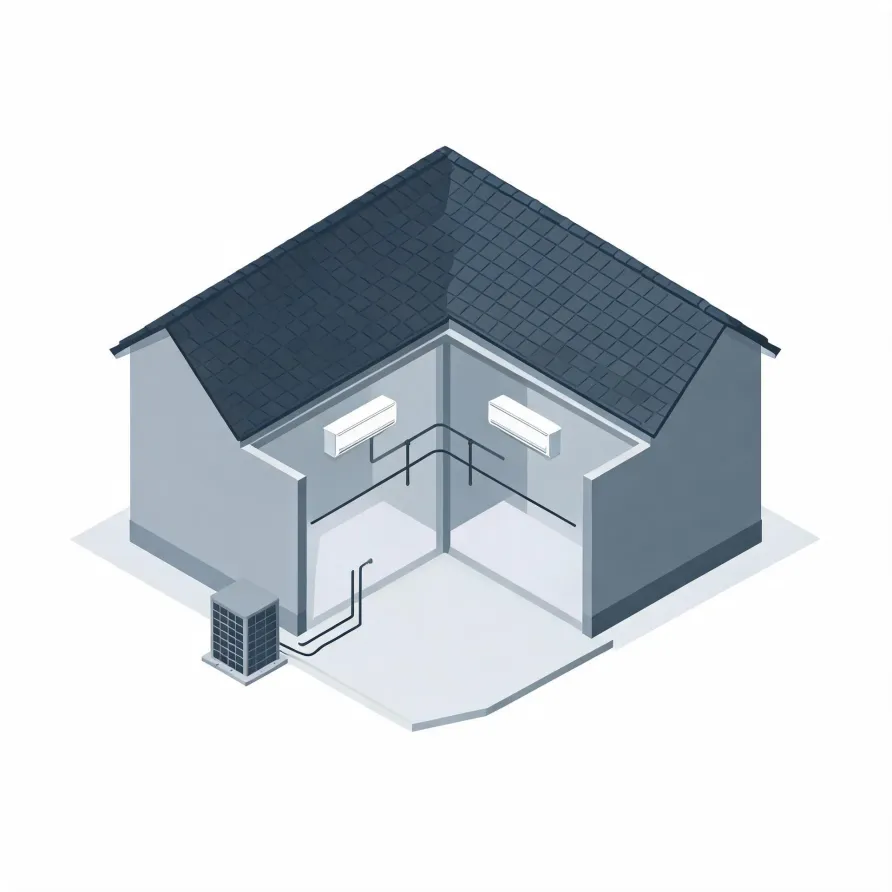
The indoor air handler mounts high on a wall inside the room and moves conditioned air directly into that space. The outdoor unit sits on the ground or on a wall bracket outside the house and carries the compressor and condenser coil. These two units are the core of every mini-split installation.
A refrigerant line set runs through a small opening in the wall and connects the indoor and outdoor units, carrying the refrigerant between them. A condensate drain line runs from the air handler to a safe discharge point, and a dedicated electrical line feeds the outdoor unit.
The drawing shows the general layout of these components, and a licensed contractor determines what applies to this particular house.
Get matched in Dade CountyDade County, Missouri, by the numbers
83 severe weather events were recorded in Dade County, Missouri between 2015 and 2024.
NOAA National Centers for Environmental Information, Storm Events Database, bulk CSV export, events 2015-01-01 through 2024-12-31.Half the homes in Dade County, Missouri were built in 1972 or earlier (2020-2024 ACS 5-year).
U.S. Census Bureau, 2020-2024 American Community Survey 5-Year EstimatesDade County, Missouri holds 3,774 housing units (2020-2024 ACS 5-year).
U.S. Census Bureau, 2020-2024 American Community Survey 5-Year EstimatesOwners occupy 77.0% of the occupied homes in Dade County, Missouri (2020-2024 ACS 5-year).
U.S. Census Bureau, 2020-2024 American Community Survey 5-Year EstimatesSevere Weather Events in Dade County
Weather puts a load on heating and cooling equipment, and that load is local. A mini-split sized and installed for what Dade County actually sees will hold up differently than one built for somewhere else.
83 severe weather events, 2015–2024. Source: NOAA National Centers for Environmental Information, Storm Events Database.