Tell us about the job
Takes about a minute. No obligation.
Compressor wear in a mini-split follows starts and stops more than calendar years, and Ray County packs those cycles into a tight summer window. Homes in Ray County, MO run cooling about three months a year, from June through August. The contactor takes a hit every time the unit kicks on, and a short season with regular afternoon demand adds up across the coil and fan motor as well. A contractor diagnosing a repair here checks the contactor and refrigerant charge first, because those are the parts that log the most stress in a season shaped like this one.
Opened equipment in a house of this vintage rarely matches what the service call looked like from the outside. Half the homes in Ray County, Missouri were built in 1974 or earlier (2020-2024 ACS 5-year). That depth of housing stock means the wiring feeding the indoor head and the outdoor compressor was put in for something different, and a contractor opening the unit finds what that previous setup left behind: undersized conductors, added-on disconnects, or refrigerant lines that have been spliced more than once. The repair scope is set by what those components actually are, not by the fault code that started the call.
The Parts of a Mini-split a Contractor Checks During Repair
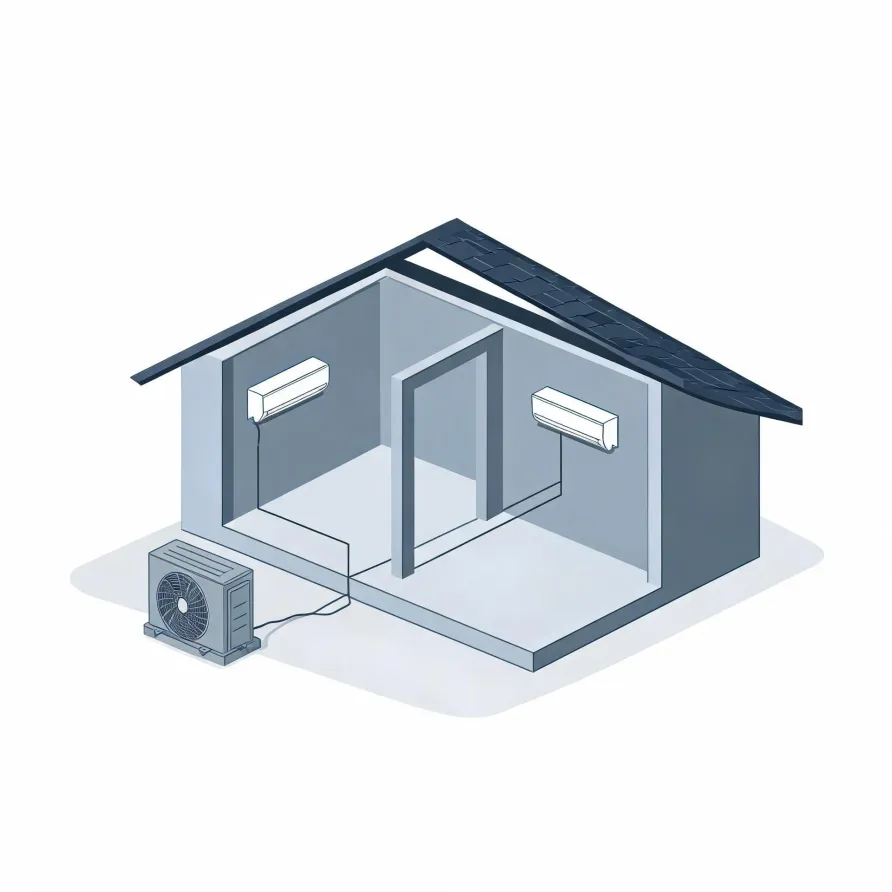
The indoor air handler mounts high on an interior wall and delivers conditioned air directly into the room. It houses the evaporator coil, a blower fan, and a filter, and any of those can be the source of a problem. When a room stops cooling or heating, or when the unit drips, makes noise, or throws an error code, this is the piece a contractor opens first.
The outdoor condenser unit sits on a pad or bracket outside the house and holds the compressor, the condenser coil, and the fan motor. A copper refrigerant line set and a control wire run between the two units through a small opening in the wall. Faults in the compressor, a refrigerant leak along the line set, or a failed control signal all trace back to this side of the system.
The drawing shows a typical layout, and a licensed contractor determines which components and connections apply to your specific installation.
Get matched in Ray CountyRay County, Missouri, by the numbers
55 severe weather events were recorded in Ray County, Missouri between 2015 and 2024.
NOAA National Centers for Environmental Information, Storm Events Database, bulk CSV export, events 2015-01-01 through 2024-12-31.Half the homes in Ray County, Missouri were built in 1974 or earlier (2020-2024 ACS 5-year).
U.S. Census Bureau, 2020-2024 American Community Survey 5-Year EstimatesRay County, Missouri holds 9,931 housing units (2020-2024 ACS 5-year).
U.S. Census Bureau, 2020-2024 American Community Survey 5-Year EstimatesOwners occupy 77.3% of the occupied homes in Ray County, Missouri (2020-2024 ACS 5-year).
U.S. Census Bureau, 2020-2024 American Community Survey 5-Year EstimatesSevere Weather Events in Ray County, Year by Year
Extreme weather puts real load on heating and cooling equipment, and that load accumulates over time. How hard the climate in this part of Missouri pushes a mini-split system shapes how often repairs come due and what a local contractor is likely to see.
55 severe weather events, 2015–2024. Source: NOAA National Centers for Environmental Information, Storm Events Database.