Tell us about the job
Takes about a minute. No obligation.
The compressor in a mini-split cycles on and off every time the house calls for cooling, and those starts add up across the service life of the unit. Homes in Howard County, MO run cooling about four months a year, from June through September. By the time a homeowner notices a fault, the compressor, the condenser fan motor, and the contactor have already absorbed years of that cycling load. A contractor diagnosing a repair here checks those parts first, because wear on them is rarely even across the system and one component typically gives before the others show anything.
Retrofitting a mini-split into a house that was never designed for one leaves decisions behind in the walls. Half the homes in Howard County, Missouri were built in 1974 or earlier (2020-2024 ACS 5-year). A contractor opening a unit that is losing capacity or throwing fault codes will check what the refrigerant lines look like where they exit the head, how the drain was routed, and whether the disconnect and feed wiring meet what the equipment actually requires. A sloppy original install is a common source of failures that look like equipment faults. The repair scope follows what the opened system and its surrounding work turn out to be.
The Parts of a Mini-split a Contractor Checks During Repair
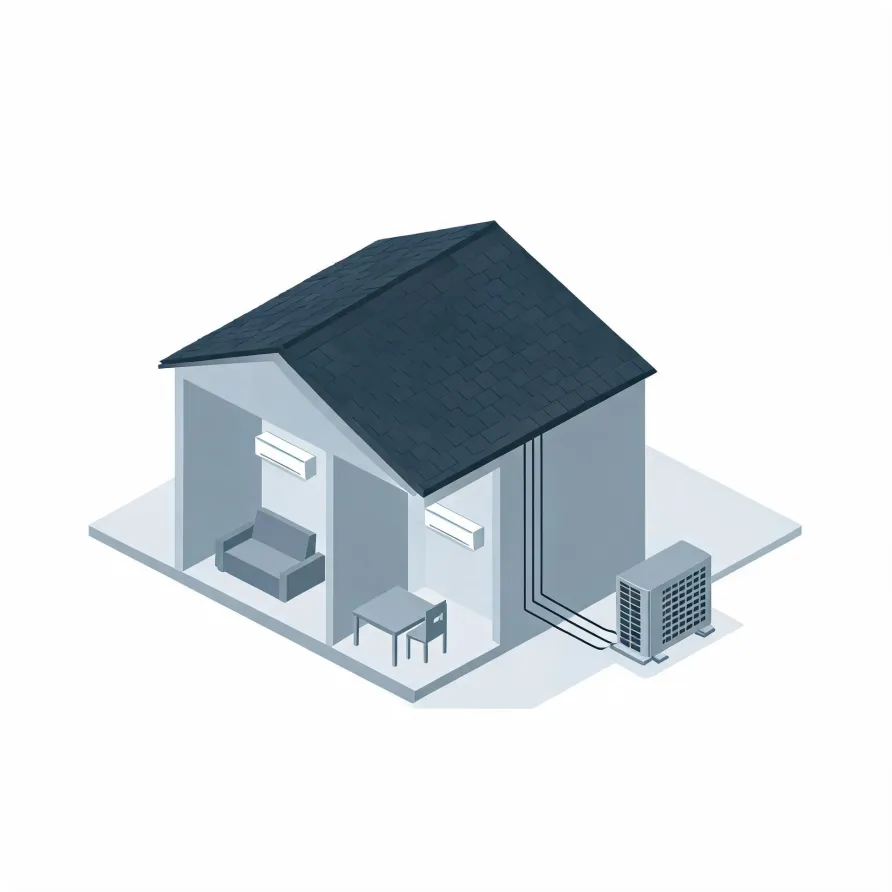
The indoor air handler mounts high on a wall inside the room and is the piece a homeowner notices first. It pulls room air across a coil and a fan to move conditioned air into the space. When this unit is the problem, the signs show up as weak airflow, ice on the coil, or air that never reaches the set temperature.
The outdoor condenser unit sits on a pad or bracket outside the house and holds the compressor, a second coil, and a fan. The refrigerant lines and the control wiring run between the two units through a small opening in the wall. A contractor checks the condenser, the lines, and the connections when the indoor unit tests out fine.
The drawing shows a typical mini-split layout, and a licensed contractor determines which components apply to your specific home and situation.
Get matched in Howard CountyHoward County, by the numbers
29 severe weather events were recorded in Howard County, Missouri between 2015 and 2024.
NOAA National Centers for Environmental Information, Storm Events Database, bulk CSV export, events 2015-01-01 through 2024-12-31.Half the homes in Howard County, Missouri were built in 1974 or earlier (2020-2024 ACS 5-year).
U.S. Census Bureau, 2020-2024 American Community Survey 5-Year EstimatesHoward County, Missouri holds 4,374 housing units (2020-2024 ACS 5-year).
U.S. Census Bureau, 2020-2024 American Community Survey 5-Year EstimatesOwners occupy 78.7% of the occupied homes in Howard County, Missouri (2020-2024 ACS 5-year).
U.S. Census Bureau, 2020-2024 American Community Survey 5-Year EstimatesSevere Weather Events in Howard County
Heating and cooling equipment in Howard County works against whatever the climate throws at it, and that workload shapes how often repairs come due. A local contractor sizing up a mini-split problem here reads the conditions differently than one working somewhere else.
29 severe weather events, 2015–2024. Source: NOAA National Centers for Environmental Information, Storm Events Database.