Tell us about the job
Takes about a minute. No obligation.
Size a mini-split wrong for this house and the compressor pays for it across every cooling season. Homes in St. Charles County, MO run cooling about four months a year, from June through September. A unit that is undersized runs longer cycles, and the contactor and condenser fan accumulate wear at a pace a correctly sized system avoids. A contractor quoting a new install has to run a proper load calculation for this house, not pull a number from the unit's label, because a system that starts and stops correctly here lasts longer than one that struggles through the heat.
Electrical panels in houses built around the early to mid nineties were sized for loads that look a lot like what a mini-split draws today. That puts St. Charles County in a different position from housing built a full generation earlier, where the gap between original service capacity and current equipment is where contractors spend most of their time. Half the homes in St. Charles County, Missouri were built in 1994 or earlier (2020-2024 ACS 5-year). A licensed contractor assessing a house here is less likely to find the panel is the problem and more likely to move straight to siting the heads, running the line set, and confirming the circuit. The electrical is worth checking, but it is rarely what changes the scope of the job.
The Mini-split Parts Involved in an HVAC Installation
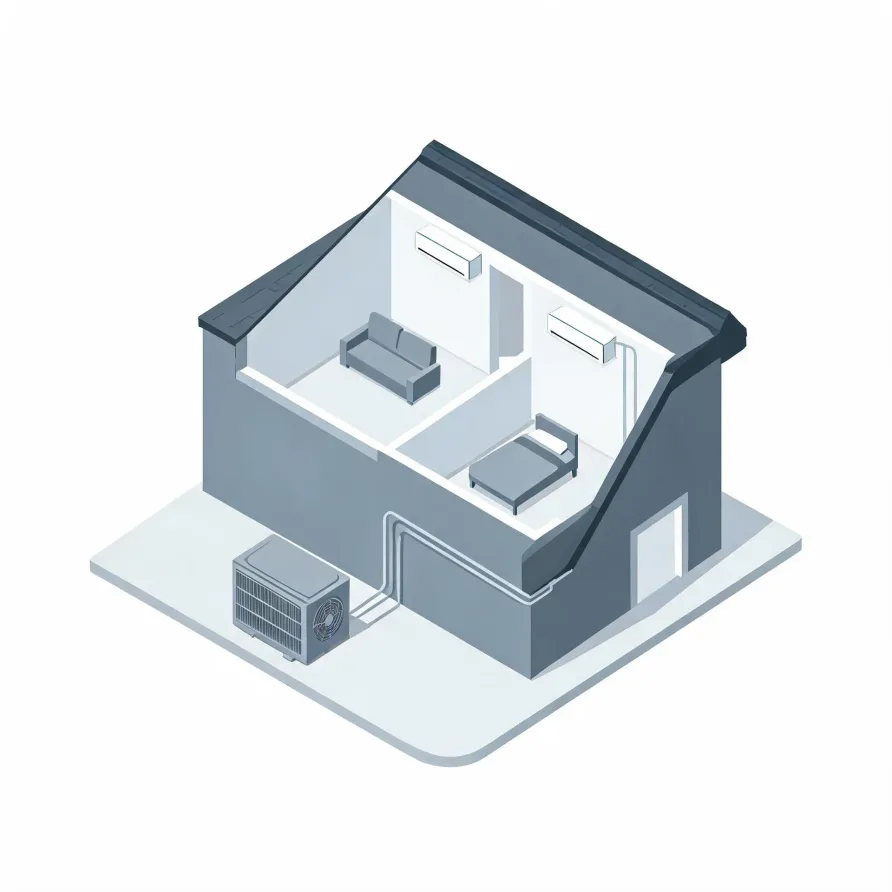
The indoor air handler mounts high on an interior wall inside the room being conditioned, and it is the piece a homeowner sees every day. The outdoor unit sits on the ground or a pad outside the house, housing the compressor and the components that drive the whole system.
A refrigerant line set runs through a small hole in the wall to connect the two units, traveling alongside a condensate drain line that carries moisture out of the indoor handler. A dedicated electrical disconnect is positioned near the outdoor unit to give a contractor safe access to the system's power.
The drawing shows a general layout of these components, and a licensed contractor determines exactly how each one applies to your home.
Get matched in St. Charles CountySt. Charles County, by the numbers
141 severe weather events were recorded in St. Charles County, Missouri between 2015 and 2024.
NOAA National Centers for Environmental Information, Storm Events Database, bulk CSV export, events 2015-01-01 through 2024-12-31.Half the homes in St. Charles County, Missouri were built in 1994 or earlier (2020-2024 ACS 5-year).
U.S. Census Bureau, 2020-2024 American Community Survey 5-Year EstimatesSt. Charles County, Missouri holds 167,163 housing units (2020-2024 ACS 5-year).
U.S. Census Bureau, 2020-2024 American Community Survey 5-Year EstimatesOwners occupy 80.5% of the occupied homes in St. Charles County, Missouri (2020-2024 ACS 5-year).
U.S. Census Bureau, 2020-2024 American Community Survey 5-Year EstimatesSevere Weather Events in St. Charles County
Weather extremes put a direct load on heating and cooling equipment, shaping how hard a system has to work and how long it holds up. A mini-split installed in St. Charles County faces whatever the local climate delivers, which makes the weather record here a real factor in sizing and installation decisions.
141 severe weather events, 2015–2024. Source: NOAA National Centers for Environmental Information, Storm Events Database.