Tell us about the job
Takes about a minute. No obligation.
Sizing a mini-split for this house means accounting for what the compressor is actually asked to do each summer. Homes in Cole County, MO run cooling about four months a year, from June through September. A compressor that is undersized for this load starts and stops harder than one matched to it, and the contactor and refrigerant circuit take that strain across every cycle. A contractor quoting a new install needs a load calculation specific to this structure before they can name a unit, because a guess in either direction costs the homeowner in component wear before the equipment reaches the age it should.
Electrical service is where a mini-split installation in Cole County gets decided, not at the point of choosing equipment. Half the homes in Cole County, Missouri were built in 1982 or earlier (2020-2024 ACS 5-year). Houses built to that point were wired for the loads of their era, and a contractor assessing a new mini-split will pull the panel before pricing anything else, checking whether the existing service can carry what the new unit draws. If it cannot, the electrical work becomes part of the job.
The Parts of a Mini-split System Being Installed
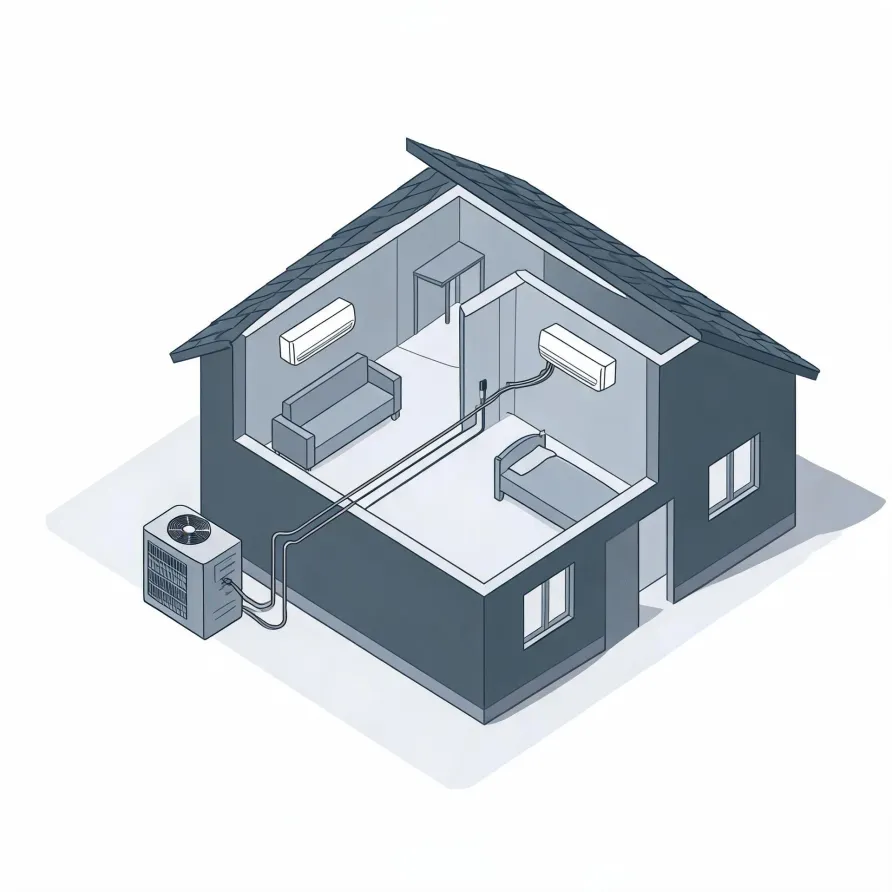
The indoor air handler mounts high on an interior wall inside the room being served. It delivers conditioned air directly into that space. The outdoor condenser unit sits outside the home, usually on a concrete pad or wall bracket, and houses the compressor and the components that shed heat to the outside air.
A refrigerant line set runs through a small hole in the wall to connect the two units, carrying refrigerant between them. A condensate drain line exits the indoor head as well, routing moisture out of the house. A dedicated power supply feeds the outdoor unit, and low-voltage communication wiring ties the two units together so they operate as one system.
The drawing shows a typical layout, and a licensed contractor determines exactly how each piece is positioned and routed for your home.
Get matched in Cole CountyCole County, by the numbers
45 severe weather events were recorded in Cole County, Missouri between 2015 and 2024.
NOAA National Centers for Environmental Information, Storm Events Database, bulk CSV export, events 2015-01-01 through 2024-12-31.Half the homes in Cole County, Missouri were built in 1982 or earlier (2020-2024 ACS 5-year).
U.S. Census Bureau, 2020-2024 American Community Survey 5-Year EstimatesCole County, Missouri holds 33,533 housing units (2020-2024 ACS 5-year).
U.S. Census Bureau, 2020-2024 American Community Survey 5-Year EstimatesOwners occupy 67.9% of the occupied homes in Cole County, Missouri (2020-2024 ACS 5-year).
U.S. Census Bureau, 2020-2024 American Community Survey 5-Year EstimatesSevere Weather Events in Cole County
Heating and cooling equipment in Cole County carries whatever load the local climate puts on it, year after year. How hard that equipment has to work is a local fact, and the weather record below is part of that picture.
45 severe weather events, 2015–2024. Source: NOAA National Centers for Environmental Information, Storm Events Database.