Tell us about the job
Takes about a minute. No obligation.
Sizing a mini-split for this county starts with understanding what the compressor is actually asked to carry. Homes in Cape Girardeau County, MO run cooling about four months a year, from June through September. That compressor cycles through every heat wave of the cooling season, starting and stopping against outdoor temperatures that push condenser efficiency down on the hottest afternoons. A contractor who skips a proper load calculation leaves the system working harder than the rated capacity was built to handle, and the contactor and refrigerant circuit are the first things to show it.
Electrical service is where a mini-split installation meets its first real question in this county. Half the homes in Cape Girardeau County, Missouri were built in 1982 or earlier (2020-2024 ACS 5-year). A house built around that period was wired for what was standard then, and a dedicated circuit for a modern ductless unit draws more than those panels were sized to give. A contractor will open the panel before any other number goes on the quote, because what is already there decides whether the installation is straightforward or whether the board itself has to be addressed first.
The Parts of a Mini-Split System Involved in an HVAC Installation
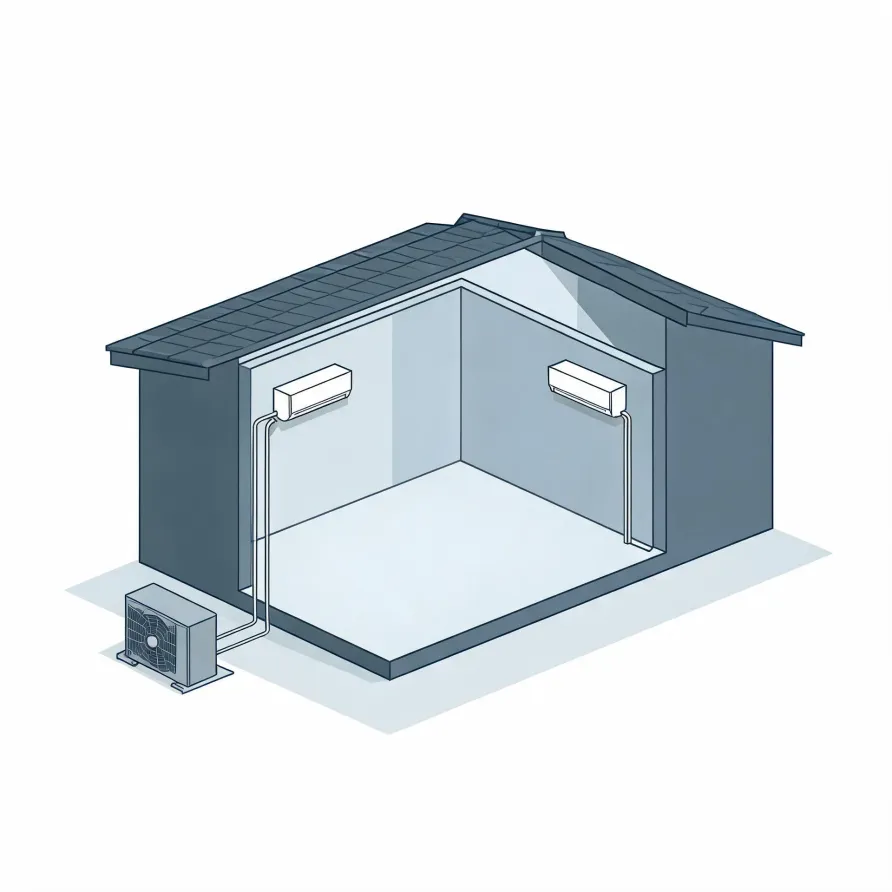
The indoor air handler is the piece a homeowner sees most often. It mounts high on an interior wall in the room being conditioned and delivers treated air directly into that space. The outdoor condenser unit sits outside the house, usually on a pad or bracket at ground level or on a wall, and houses the compressor and coil that do the heavy mechanical work.
A refrigerant line set runs between the two units through a small penetration in the wall, carrying refrigerant back and forth. A condensate drain line exits the indoor unit and routes moisture out of the building. A dedicated electrical circuit feeds the outdoor unit, with a disconnect box mounted nearby.
The drawing shows a general layout of these components, and a licensed contractor determines exactly how they apply to your home's specific configuration.
Get matched in Cape Girardeau CountyCape Girardeau County, by the numbers
160 severe weather events were recorded in Cape Girardeau County, Missouri between 2015 and 2024.
NOAA National Centers for Environmental Information, Storm Events Database, bulk CSV export, events 2015-01-01 through 2024-12-31.Half the homes in Cape Girardeau County, Missouri were built in 1982 or earlier (2020-2024 ACS 5-year).
U.S. Census Bureau, 2020-2024 American Community Survey 5-Year EstimatesCape Girardeau County, Missouri holds 36,086 housing units (2020-2024 ACS 5-year).
U.S. Census Bureau, 2020-2024 American Community Survey 5-Year EstimatesOwners occupy 66.8% of the occupied homes in Cape Girardeau County, Missouri (2020-2024 ACS 5-year).
U.S. Census Bureau, 2020-2024 American Community Survey 5-Year EstimatesSevere Weather Events in Cape Girardeau County
Weather patterns in Cape Girardeau County put real demands on heating and cooling equipment over its working life. A mini-split sized and installed for local conditions handles those demands better than one specified for somewhere else.
160 severe weather events, 2015–2024. Source: NOAA National Centers for Environmental Information, Storm Events Database.